

America at a Crossroad
Threats from Within
By G. Lee Southard, PhD Crisis in America October 28, 2020
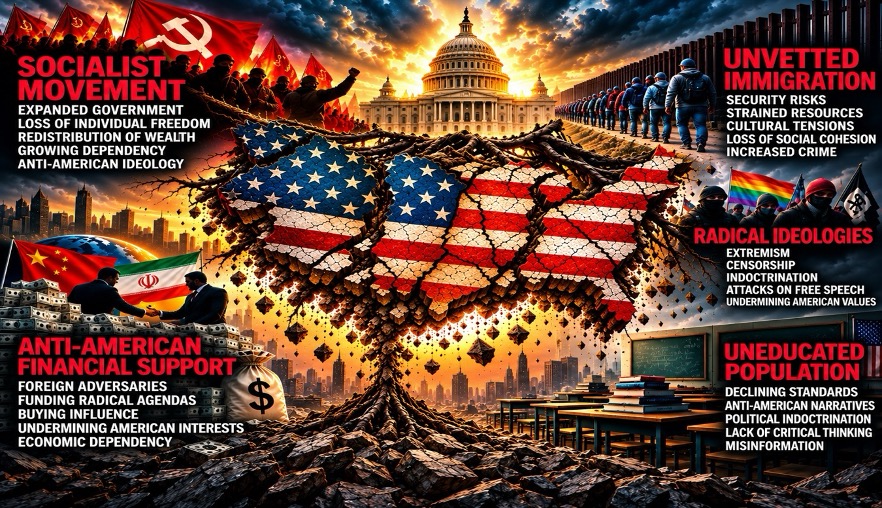
Five developments deserve particular attention: illegal and inadequately vetted immigration, especially when accompanied by resistance to assimilation or threats to national security; the growing appeal of socialism; an educational system that too often fails to demand academic excellence; political leaders who place personal ambition and power above the national interest; and wealthy individuals and organizations that financially support movements whose objectives may undermine America’s founding principles.
Immigration, Assimilation, and National Security
America has long welcomed immigrants who seek freedom, opportunity, and a better life. Generations of immigrants have contributed enormously to our nation’s prosperity and strength. However, illegal immigration and inadequate vetting raise legitimate concerns about national security, respect for the rule of law, and the preservation of our shared civic values.
Of particular concern are individuals who enter the United States with no intention of respecting its laws or constitutional principles, and especially those who seek to do Americans harm. Immigration should not require individuals to abandon their cultural heritage, but it should require respect for the laws, freedoms, and civic responsibilities that have made America a destination for people throughout the world.
Those who seek to undermine America’s constitutional freedoms should recognize the contradiction in benefiting from the very liberties they would deny to others.
Public attitudes toward immigration, religion, and national security reflect considerable concern. One survey reported that 51% of Americans considered Muslims more likely than members of other religions to encourage violence. ¹ Another reported that only 17% believed Muslims had a positive impact. ² These findings, if accurately reported, describe public perceptions rather than establish the beliefs or conduct of Muslims generally. It is important to distinguish legitimate concerns about religious extremism from judgments about an entire religious population.
Immigration also reveals a substantial political divide. One survey reported that 60% of Republicans considered illegal immigration a national problem, compared with only 17% of Democrats. ³ Such differences illustrate how deeply divided Americans have become over an issue involving national sovereignty, security, and the rule of law.
The Growing Appeal of Socialism
For decades, America has experienced an expanding debate over the proper role of government in economic and personal life. I believe the increasing appeal of socialism represents a serious challenge to the principles of individual liberty, personal responsibility, private enterprise, and limited government that have contributed to America’s success.
The historical record demonstrates the dangers of authoritarian communist systems, including the suppression of political freedom, restrictions on private property, and the concentration of power in the state. Although democratic socialism and communism are distinct political and economic systems, Americans should carefully examine proposals that would substantially expand government authority and dependency.
The growing popularity of socialism among younger Americans is particularly troubling to those who value free enterprise. A Harris poll reportedly found that 61% of Americans ages 18–24 favored socialism, while 43% embraced some form of socialism. The precise wording and meaning of these findings deserve examination, but they raise important questions about how younger generations understand capitalism, socialism, and the historical consequences of different economic systems.
Promises of extensive government benefits can be politically attractive. Yet every government program must ultimately be financed through taxation, borrowing, or other economic costs. What government promises as free is never without cost.
The Failure of American Education
An informed citizenry is essential to the survival of a constitutional republic. Unfortunately, our educational system has too often failed to provide students with the historical knowledge, critical-thinking skills, and academic discipline necessary to understand and preserve the freedoms they have inherited.
Too many young Americans leave school without a sufficient understanding of the Constitution, the principles of representative government, the responsibilities of citizenship, or the history of political and economic systems.
When citizens lack historical knowledge, they become more vulnerable to appealing rhetoric, unrealistic promises, and political movements whose consequences they may not fully understand.
Educational excellence requires more than access to schooling. It requires rigorous academic standards, measurable achievement, knowledgeable teachers, parental involvement, and the expectation that students will master essential subjects.
Schools should teach students not merely what to think, but how to examine evidence, evaluate competing arguments, understand history, and reach informed conclusions.
A nation that fails to educate its citizens about the foundations of its freedom risks losing the very liberties previous generations sacrificed to secure.
Where Have the Statesmen Gone?
Where are the statesmen who place country above party, principle above popularity, and public service above personal ambition?
Public confidence in Congress remains deeply troubled. One cited survey reported that 86% of Americans disapproved of Congress. ⁴ Such dissatisfaction raises serious questions about whether elected representatives are adequately responding to the concerns and interests of the people they serve.
Too many political leaders appear more concerned with reelection, campaign contributions, party loyalty, and the accumulation of power than with pursuing policies that serve the long-term interests of the nation.
Political leadership requires the courage to make difficult decisions, defend constitutional principles, and place national interests above personal or partisan advantage.
Both major political parties should be held accountable when their actions conflict with the principles they profess to defend. Americans deserve representatives who demonstrate integrity, independence, competence, and a genuine commitment to public service.
America needs statesmen, not merely politicians.
The Financial Power Behind Political Movements
Political and cultural movements rarely achieve widespread influence without substantial financial support. Wealthy individuals, foundations, corporations, and advocacy organizations can provide the resources necessary to shape public opinion, influence educational institutions, support political campaigns, and advance ideological objectives.
Financial participation in public affairs is a legitimate exercise of constitutional freedom. However, serious questions arise when powerful financial interests support organizations or movements whose stated objectives conflict with America’s constitutional principles, democratic institutions, or national security.
Americans should demand greater transparency regarding the sources of political funding, the objectives of organizations receiving that funding, and the influence of major donors on public policy.
Supporting an unpopular or controversial political position is not, by itself, treason. Nevertheless, knowingly financing unlawful violence, terrorism, or other activities intended to harm the United States warrants appropriate investigation and accountability under the law.
Financial influence must never become a substitute for democratic accountability or a means of undermining the constitutional freedoms that make such influence possible.
The Responsibility Before Us
America’s greatest challenges do not always come from foreign adversaries. Some arise from weaknesses within our own institutions, failures of leadership, inadequate education, political polarization, and the gradual erosion of shared civic responsibilities.
The preservation of freedom requires more than patriotic words. It demands informed citizens, strong families, effective schools, responsible immigration policies, principled leadership, transparent political financing, and unwavering respect for the Constitution and the rule of law.
As Americans prepare to vote, we should examine not only candidates’ promises but also their records, principles, judgment, and commitment to the nation’s long-term welfare.
Freedom is not self-sustaining. We must understand it, defend it, and pass it to each succeeding generation.
America’s future depends not simply on who wins an election, but on whether its citizens remain willing to accept the duties and responsibilities necessary to preserve the republic.
Freedom. Duty. Honor. Country. These must remain more than words. They must remain the principles by which America lives.
References:
- Pew Research Center January 2026.
- Pew Research Center May 2026.
- Pew Research Center April 2026.
- Pew Research Center July 2026 and Gallup October 2026
Research Articles;
American Christian History Biblical Worldview
Book Announcement Christian Life
Resolving Doubt Science and Faith
Books & Publications:

| Available at:Amazon Barnes & Noble WestBow Publishers Know With Certainty |