G. Lee Southard/Our Christian Heritage/ October 8, 2026
In a previous post, Celebrating Christianity in America, I introduced a recently written hymn, “Awaken Us Today.” Written for the film A Great Awakening, set in the years preceding the American Revolution, it is truly an American hymn for our times.
Today, however, I want to take you back nearly 1,700 years and introduce you to one of the earliest surviving Christian hymns and still a hymn for us today.
THE OXYRHYNCHUS HYMN
Beginning in 1896, archaeologists Bernard Grenfell and Arthur Hunt excavated the ancient Egyptian city of Oxyrhynchus, where enormous quantities of discarded papyrus had survived for centuries in the dry Egyptian climate.
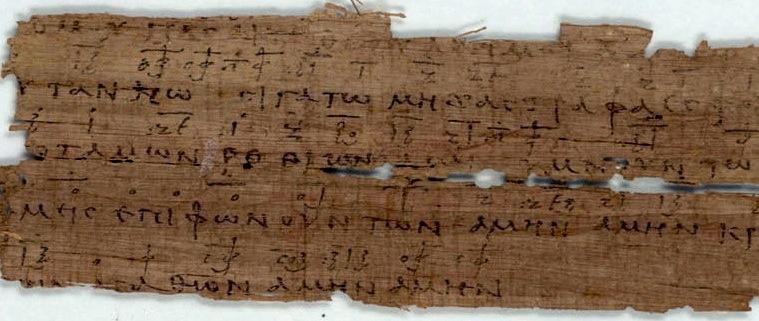
Among these discoveries was an extraordinary fragment now known as the Oxyrhynchus Hymn (P. Oxy. XV 1786), generally dated to the late third century—approximately AD 250–300. It is housed at the Art, Archaeology and Ancient World Library, which was formerly called the Sackler Library.
Archaeologically, the papyrus is remarkable because musical notations appear above the Greek words.
This means that scholars can reconstruct, at least approximately, not only what Christians were singing some 1,700 years ago, but also how they may have sung it.
But the music is not the most remarkable part.
The words themselves tell us something important about what Christians believed.
A translation reads approximately:
Let all the glorious creations of God be silent;
let the shining stars not sound forth.
Let the rushing winds and all the roaring rivers cease,
while we hymn the Father, Son, and Holy Spirit.
Let all the powers answer, “Amen, Amen.”
Praise and glory forever to God alone,
the giver of all good things. Amen.
Notice those words:
“Father, Son, and Holy Spirit.”
That is what makes this ancient hymn theologically significant.
The Council of Nicaea would not convene until AD 325, and the Council of Constantinople would follow in AD 381. Those councils played crucial roles in defining the Church’s theological language concerning the relationship of the Father, Son, and Holy Spirit.
But this hymn provides striking physical evidence that Christians were already worshiping God in explicitly Trinitarian language before Nicaea.
The doctrine did not suddenly appear in AD 325.
Its foundations were already present in the New Testament—for example, in Jesus’ command to baptize “in the name of the Father and of the Son and of the Holy Spirit” (Matthew 28:19) and in Paul’s benediction invoking Jesus Christ, God, and the Holy Spirit (2 Corinthians 13:14).
The Oxyrhynchus Hymn therefore gives us something remarkable: archaeological evidence from the centuries before Nicaea showing Christians singing their faith in the Father, the Son, and the Holy Spirit.
Nearly seventeen centuries later, Christians still worship the same God.
If you would like to hear a modern reconstruction of how this ancient hymn may have sounded, listen here:
https://www.youtube.com/watch?v=dhbE6DaUk8o
| Books by G. Lee Southard |
 |
| Available at: Amazon at https://www.amazon.com Barnes & Noble at https://www.barnesandnoble.com WestBow Publishers at https://www.westbowpress.com/en/bookstore. Know With Certainty at https://toknowwithcertainty.com |
| To Know With Certainty Fort Myers, Florida 33908 Phone: 239-410-2771 lee@toknowwc.com |
| Visit www.ToKnowWithCertainty.com Like Us on Facebook Follow Us on Twitter and InstagramWant to change how you receive these emails? You can update your preferences or unsubscribe from this list. |