Celebrating Christianity in America
The Religious Landscape of America Prior to the Revolution
By G. Lee Southard
In the first article of the Christianity in America series, we highlighted the 461-year history of Christianity in America brought to the New World by Europeans seeking religious freedom. But what was Christianity like in early America?
The Extent of Religion in America 1750
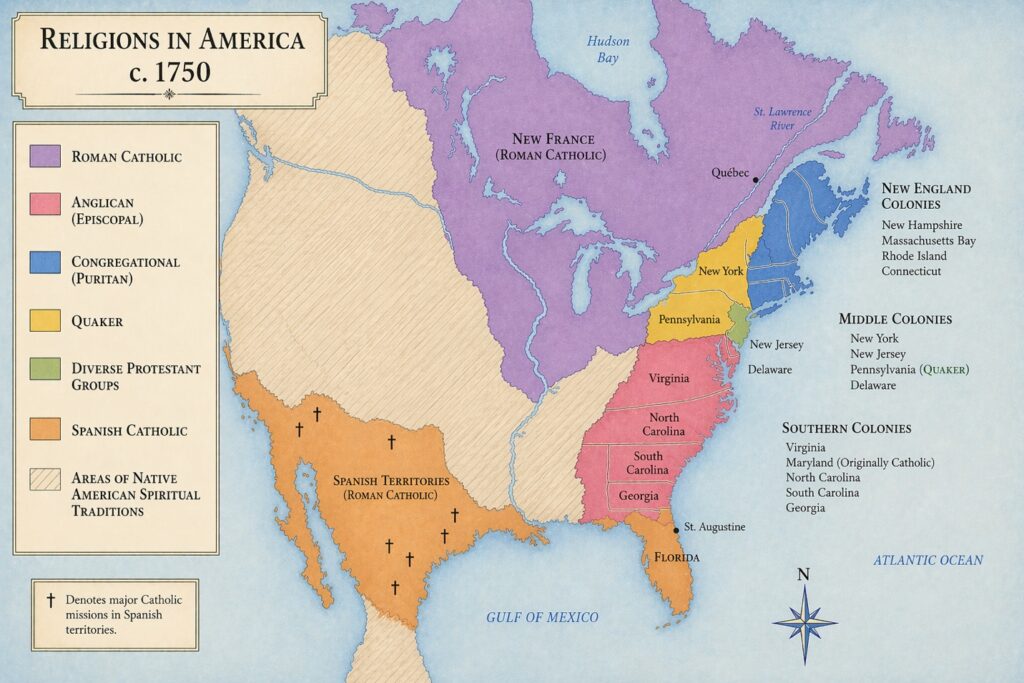
From the 1600s through the mid-1700s, French explorers and settlers in Canada established a network of trading posts and settlements west of the Appalachian Mountains, extending as far as present-day South Dakota. As they expanded, they introduced Roman Catholicism through missionary efforts directed at Native American populations.
At the same time, Scotch-Irish immigrants migrated from Northern Ireland to the American colonies between 1717 and 1775. Settling primarily along the Appalachian frontier from Pennsylvania southward, these predominantly Presbyterian settlers sought relief from religious, economic, and political pressures. Their presence helped establish a strong Protestant influence in the interior regions.
In New England, the Puritans—originally a reform movement within the Church of England—settled in Massachusetts, Connecticut, and New Hampshire. They aimed to build communities grounded in their religious convictions and enforced strict doctrinal conformity. This rigidity led to the persecution of dissenters, most notably prompting Roger Williams to establish Rhode Island as a haven for religious liberty. There, Baptists, Quakers, and other dissenting groups found refuge.
The Middle Colonies, particularly Pennsylvania, became the most religiously diverse region. Founded by William Penn as a Quaker colony, Pennsylvania was known for its commitment to religious tolerance. In addition to Quakers, the region attracted Dutch Reformed, Lutheran, and Presbyterian settlers, creating a pluralistic religious environment.
In the Southern Colonies—Virginia, Maryland, and the Carolinas—the Anglican Church was formally established and held significant cultural influence. However, by the mid-1700s, Baptists and other dissenting groups were growing rapidly, often seeking greater religious freedom. Despite Anglican dominance, many ministers reported low levels of engagement, describing congregations as inattentive and spiritually disengaged. 1
By 1776, the colonies had about 3,200 churches, yet fewer than 20 percent of the population were formal members. 2This statistic does not necessarily reflect the depth of belief, as many colonists lived in dispersed frontier areas where regular attendance was difficult.
A major turning point came with the First Great Awakening, beginning around 1730. Led by figures such as Jonathan Edwards in Massachusetts and the British evangelist George Whitefield, this movement emphasized personal conversion, spiritual renewal, and emotional engagement. Whitefield’s preaching drew large crowds across the colonies and influenced multiple denominations.
The First Great Awakening fostered a heightened sense of personal responsibility before God, emphasizing individual conviction of sin and the need for redemption. It encouraged introspection and moral commitment while shifting focus away from rigid institutional structures. Faith became understood as a personal decision rather than one mediated solely through established churches.
Historians often identify these developments as contributing to the intellectual and moral foundation of the American Revolution. People frequently used religious language and biblical themes to justify resistance to British authority. Even figures such as Thomas Paine framed the struggle in moral terms, presenting resistance as a duty grounded in higher principles.
During this period, American society increasingly challenged established authority in both church and state. Ministers played influential roles in public life, using sermons to connect colonial grievances with biblical concepts of justice, liberty, and rights.
The Revolution itself was often expressed in explicitly moral language. Terms such as “Creator,” “Divine Providence,” and “Supreme Judge of the world,” found in foundational documents, reflect a worldview shaped in part by religious belief and contributed to the perceived legitimacy of the revolution’s cause.
The Christian foundation influenced not only the church’s mission but also the formation of a new kind of government—one unlike any previously seen in history. It was a republic grounded in the conviction that individuals possess inherent worth and responsibility, endowed not by the state but by God. In this framework, the primacy of the individual was inseparable from moral accountability, and liberty was understood as a gift to be exercised within the bounds of truth.
1. Jacob M. Blosser, “Irreverent Empire: Anglican Inattention in an Atlantic World,” Church History, Sept 2008, Vol. 77 Issue 3, pp. 596–628
2 Center for the Study of the Presidency and Congress Religion in the Revolutionary Period, https://www.thepresidency.org/religion